
Cybersecurity solutions for legal practices

Cybersecurity solutions for legal practices
Reputable legal practices don’t just offer legal protection, guidance and support to their clients. They also offer a place to store privileged communications, financial data and extremely sensitive information. However, with cybercriminals targeting law firms to gain access to this data, organizations face a difficult challenge in finding the right methods of online protection.
The first step in strengthening cybersecurity for law firms is understanding which threats to be aware of and how to prevent them. To help reduce the risk of losing sensitive data and breaching data protection guidelines, here’s Frontline Managed Services’ guide to the types of cybersecurity solutions for legal practices.
Common Cybersecurity Threats Facing Legal Practices
While the specific costs of cybercrime will depend on each organization, the industry they operate in, and their location worldwide, the average global cost of a data breach is around $4.35 million. Legal practices handle sensitive and private data every day, which can make them a prime target for cybercriminals and subsequent breaches.
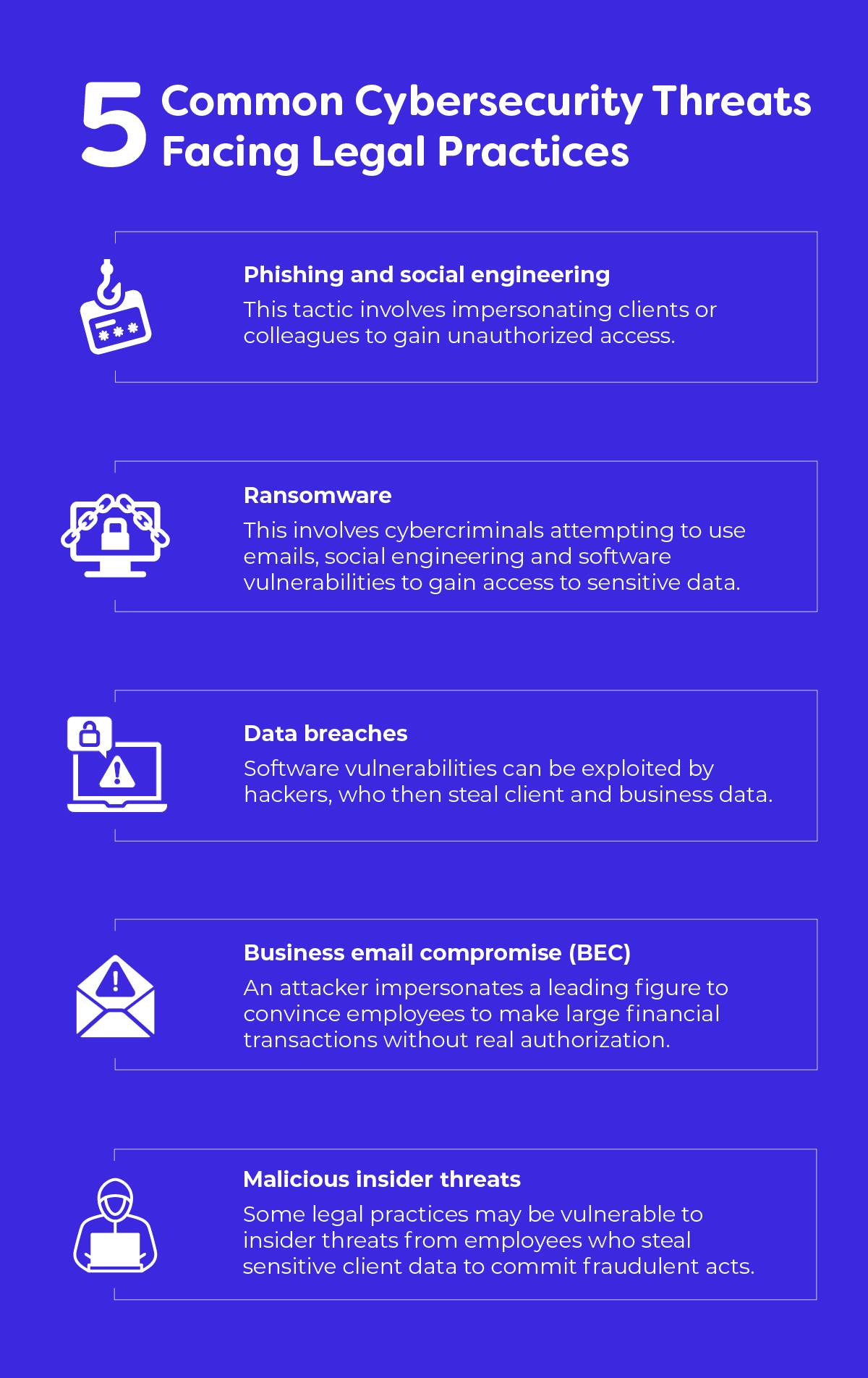
Understanding the risks organizations face is the first step to ensuring cybersecurity for law firms. The following are some common cybersecurity threats facing legal practices:
- Phishing and social engineering: This tactic involves impersonating clients or colleagues to gain unauthorized access. It can result in an employee divulging sensitive data or wiring money to a fake account. Modern phishing attacks are sophisticated, and it can be challenging to distinguish them from real people.
- Ransomware: This involves cybercriminals attempting to use emails, social engineering and software vulnerabilities to gain access to sensitive data. This data is then encrypted before cybercriminals demand a ransom to be paid for its return. For law firms, this can lead to an inability to serve clients while having to pay a ransom for files that may never be recovered.
- Data breaches: Software vulnerabilities can be exploited by hackers, who then steal client and business data. The compromised data can lead to financial penalties, legal ramifications and significant damage to a legal practice’s reputation.
- Business email compromise (BEC): Similar to a social engineering scam, BEC involves an attacker using social engineering. However, during a BEC scam, an attacker impersonates a leading figure within the law firm to convince employees to make large financial transactions without real authorization.
- Malicious insider threats: Not all cybersecurity threats come from external forces. Some legal practices may be vulnerable to insider threats from employees who steal sensitive client data to commit fraudulent acts.
Cybercrime can cause a wide range of problems for law firms. These combined threats can cause legal practices to breach contracts and lead to claims of negligence against clients.
How to Assess Your Law Firm’s Cybersecurity Risk
As industries worldwide look for solutions to online threats, the cybersecurity market continues to grow to reflect this need, predicted to reach $262.29 billion by 2030. To ensure that budgets aren’t spent on the wrong areas, it’s essential to understand which security measures will work for your organizational needs.
Knowing how to assess your law firm’s cybersecurity risk can help you improve vigilance and make the most cost-effective decisions. You can achieve this goal by:
- Identifying sensitive data assets, which typically include financial data, case files and client information.
- Considering where those assets are stored, such as cloud software, servers or employee laptops.
- Internally checking where systems and processes are weakest, like poor awareness training or outdated security measures.
- Determining the threat and impact — consider which threats apply to your legal practice and evaluate the potential outcomes in terms of financial loss and fines.
You should also assess your law firm’s risk regarding any regulatory obligations. For example, if your firm is subject to GDPR, HIPAA or Bar Association laws that need to be adhered to, it can play a role in determining which cybersecurity solutions work for you.
Choosing the Right Types of Cybersecurity for Law Firms
Knowing how to choose the right cybersecurity solutions for your legal practice can be the difference between preventing a cyberattack and losing confidential data. And with cyberattack threats continuing to grow through sophisticated artificial intelligence crimes, cybersecurity is a vital part of any business strategy.
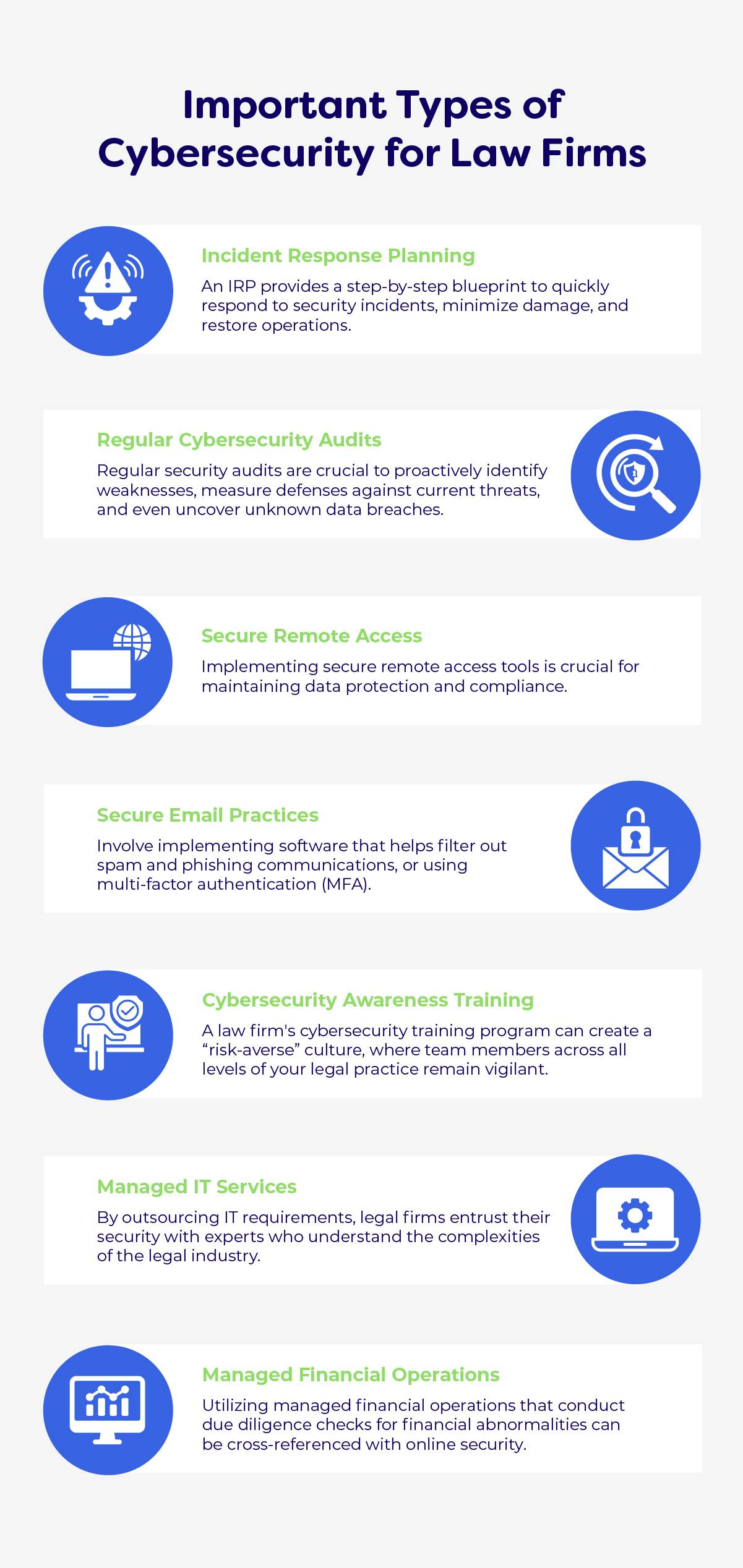
Below are the most important types of cybersecurity for law firms to protect their reputation, data and clients.
Incident Response Planning
It doesn’t matter how big or reputable a legal practice is. Every firm is susceptible to cybercrime. Even organizations with robust defenses in place can experience a cybersecurity incident. To mitigate the damage of a potential cybersecurity risk, it’s essential to have an incident response plan (IRP) in place. Think of it as a guideline that explains a step-by-step response plan for when a security issue occurs.
Having an incident response plan gives your legal practice an effective blueprint. It means your team can respond immediately to a security incident by removing the threat, minimizing damage and helping restore standard operations as quickly as possible.
Some key details of a strong incident response plan include:
- Specific instructions for each phase of a cybersecurity incident, from threat detection to data recovery.
- Clearly defined roles with designated team members as points of contact.
- Clearly defined responsibilities for colleagues.
- Clear instructions on the priority data and systems to recover.
- Guidance on how to access current data backups.
Implementing these steps alongside drills and regular training can ensure every colleague understands what’s expected of them. It also offers an opportunity to reassess any weak areas of an IRP. While regulations on data breaches vary, most laws, including GDPR and some U.S.-specific sectors, require a data breach to be reported within 72 hours of discovery. However, this will not always be the case, as there are many jurisdictions to consider depending on your specific practice.
Regular Cybersecurity Audits
Cybercriminals depend on legal practices becoming complacent with their online security. By conducting regular security audits, you can stay one step ahead of these risks by constantly measuring your preventive measures against the latest threats. Some cybersecurity audits can even pinpoint data breaches that a law firm didn’t know about.
A robust audit will include a deep dive into your operational systems, software and data storage to find those vulnerable areas in your networks. Vulnerability management is a key part of a more secure network, as constantly scanning and patching systems helps narrow down those unexpected security gaps.
Secure Remote Access
Technological advancement and post-COVID-19 work culture have seen a significant rise in remote working over the years. While this offers a more flexible working schedule for law firms, it presents a new set of cybersecurity risks to contend with.
Workers conducting business at home may unintentionally use a Wi-Fi network that’s not secure enough to protect client data. Or, an employee may use a personal device to share or discuss sensitive client information, leading to a lack of compliance.
Secure remote access tools can help maintain the same safety practices in-office and at home, including:
- Managed cloud monitoring: This helps reduce configuration overload and simplify solutions for mitigating risk in cloud systems for legal practices.
- Endpoint detection and response (EDR): This takes security measures past standard antivirus solutions to check computers, laptops and other endpoints for suspicious activities.
- Firewalls and network security: A well-managed firewall can block or flag suspicious network traffic and implement a companywide secure VPN for remote workers.
These small remote access measures can lead to a more secure remote security system, giving clients another reason to trust you with their most precious information.
Secure Email Practices
Email communications are an essential part of modern legal practices. However, the constant demand to converse with clients and colleagues via email can lead to poor habits and a lack of vigilance. While choosing the right types of cybersecurity for law firms isn’t always easy, an email security policy plan is critical for any law firm.
Secure email practices can be simple, but their effectiveness can’t be overlooked. Some key components of secure email practices involve implementing software that helps filter out spam and phishing communications, or using multi-factor authentication (MFA).
MFA can provide your firm with that extra level of security by asking for more than one form of login verification. This can include sending a code to your phone or a fingerprint scan, which helps prevent a full-scale security issue even if a hacker does manage to obtain your password.
Cybersecurity Awareness Training
It’s not just about technical security. Cybersecurity for law firms should also include regular awareness training. Technological advancements move fast, and working in the legal industry is complex enough. Many colleagues aren’t aware of the latest online threats that businesses should be on the lookout for.
There are many benefits of a robust cybersecurity awareness training plan for legal firms, team members and clients, including:
- Clients: Telling clients that their data is safe isn’t the same as showing them. Awareness training tells existing and potential clients that your organization is serious about protecting their data.
- Legal firms: Having cybersecurity awareness training in place can contribute to compliance with any regulatory bodies, and reduces wasted time and disruptions in the event of a breach.
- Staff members: Employees who receive security training can quickly spot potential risks, respond more effectively to problems and contribute to minimizing any reputational or financial damage.
A law firm’s cybersecurity training program can create a “risk-averse” culture, where team members across all levels of your legal practice remain vigilant. By keeping this security training as part of a regular schedule, good practices will soon become habitual, and potential risks will be easier to spot.
Managed IT Services
For many organizations, legal or otherwise, cybersecurity risks are better handled by enlisting the help of managed IT services. By outsourcing IT requirements, legal firms entrust their security with experts who understand the complexities of the legal industry to deliver client satisfaction, disaster recovery procedures and long-term security measures aligned to business objectives.
Managed IT services can provide expert support through a wide range of offerings, including:
- Network monitoring: Managed IT services with network monitoring in place helps reduce downtime through early risk detection and 24/7 support. It can also involve simplifying risk reports to meet specific industry standards, and automate some of the general security tasks involved with in-house IT to save costs.
- IT engineering support: This support, when implemented as part of a managed IT services initiative, ensures that business-related IT projects run without issue and adhere to technical requirements. IT engineering support solutions can also help unify clients, project team members and stakeholders to work in tandem, reducing time and labor costs.
Legal practices that work with managed IT services can stay ahead of technology trends. This not only helps deliver client security but also offers a competitive edge when clients are considering which law firm to do business with.
Managed Financial Operations
There are some strategic security and administrative measures to consider when it comes time to assess your law firm’s cybersecurity risk. While managed financial operations may seem unrelated to cybersecurity, they’re both commonly used in legal practices, which presents a “wild card” opportunity for organizations.
Utilizing managed financial operations that conduct due diligence checks for financial abnormalities can be cross-referenced with online security. For example, conflicting payments or suspicious payment activities may be traced back to potential cybersecurity breaches that went unnoticed.
Building a Secure and Resilient Legal Practice
Having a proactive and robust security plan in place isn’t so much a choice, but a modern expectation from a client and regulatory perspective. For industries like law, where lots of sensitive data and case files are shared on a daily basis, having the right support can streamline processes and show clients how trustworthy your business is.
When determining what cybersecurity solutions will work for your organizational needs, considering potential areas of weakness, communicating with colleagues and teaming up with managed IT services can make a world of difference.
This story was produced by Frontline Managed Services and reviewed and distributed by Stacker.


