
How to open a business bank account

How to open a business bank account
Opening a business bank account is one of the first real steps in building a legitimate company. It’s also one of the easiest to delay if you don’t prepare.
Banks care about three things: identity, legality, and compliance. Bring the right documents, and you can open an account in as little as a day with online platforms—though traditional banks may still take 1-2 weeks. Miss one, and you're stuck in a loop of emailing PDFs back and forth.
This guide from Ramp covers exactly what you need to open a business bank account, how requirements differ by business type, and how to choose the right account for your company.
Quick checklist
- Government-issued ID for all signers
- EIN or SSN
- Business formation documents
- Licenses or permits (if required)
- Proof of business address
- Initial deposit
- Ownership details for 25%+ owners
Get these right, and opening a business account is quick.
Why you need a dedicated business bank account
Even if you’re a sole proprietor, separating business and personal money isn’t optional if you want to grow.
Legal protection
For LLCs and corporations, commingling funds can jeopardize liability protection. If business and personal expenses mix, courts can hold you personally responsible for business debts.
Cleaner accounting
A single account for business income and expenses makes reconciliation, audits, and tax prep faster. No guesswork. No personal transactions muddying the books.
Professional credibility
Clients and vendors see your business name on payments—not your personal name. That matters when you’re negotiating contracts or getting paid faster.
Better cash visibility
When all cash flows through one place, you can track burn, spot issues early, and make smarter decisions about hiring, spend, and growth.
What banks require to open a business account
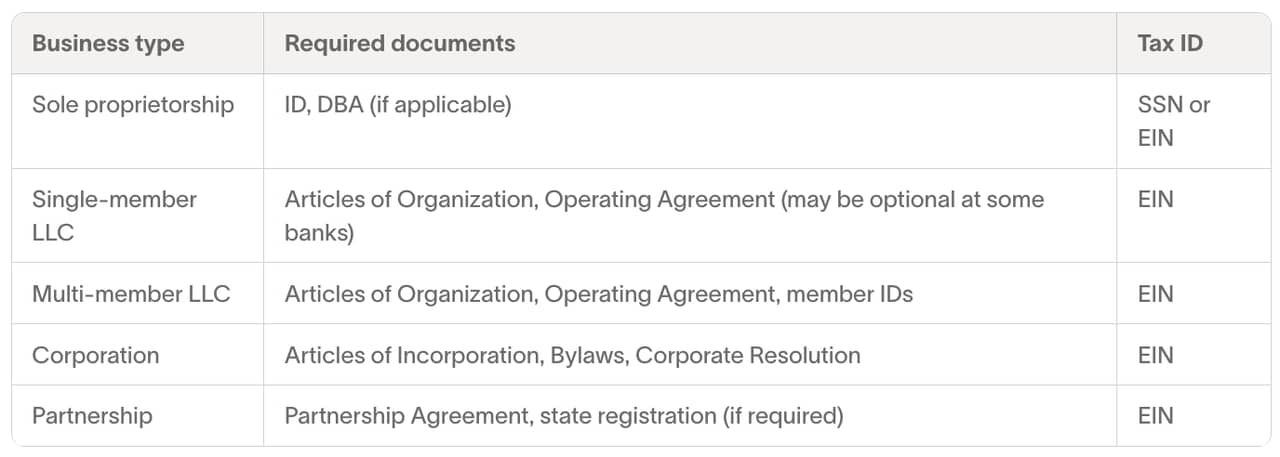
Most banks ask for the same core information. The differences show up by business structure and industry.
1. Government-issued photo ID
Every authorized signer must provide a valid ID, such as:
- Driver’s license
- State-issued ID
- Passport
Expired IDs will stall your application.
2. EIN (or SSN in limited cases)
An Employer Identification Number (EIN) is required for:
- LLCs
- Corporations
- Partnerships
Sole proprietors operating under their own legal name typically only need an SSN. However, if you're using a DBA (doing business as) name, you'll need an Assumed Name Certificate or similar documentation. Many banks still prefer an EIN regardless, as it provides cleaner separation and better protects your SSN. Applying is free and takes about 15 minutes on the IRS website.
3. Business formation documents
These prove your business legally exists.
- Sole proprietor: DBA certificate (only if operating under a name different from your legal name)
- LLC: Articles of Organization
- Corporation: Articles of Incorporation
- Partnership: Partnership agreement
Banks usually accept digital copies, but some require certified versions.
4. Business licenses or permits (if applicable)
Required in regulated industries like construction, healthcare, food service, and financial services.
5. Ownership information
Federal rules require banks to identify anyone who owns 25% or more of the business. Be ready with names, addresses, and ownership percentages. Note: This requirement does not apply to sole proprietors.
6. Initial deposit
Initial deposit requirements vary widely. Many modern business accounts require no minimum deposit, while traditional banks typically ask for $25-$100 for basic accounts and higher amounts for premium services.
7. Proof of business address
Banks need documentation showing your business's physical location. This can be a lease agreement, utility bill, or business property deed.
Requirements by business structure
Traditional banks vs. online and platform-based banking
You’re not limited to brick-and-mortar banks anymore. Each option has tradeoffs.
Traditional banks
Best if you handle cash or want in-person service.
- Physical branches and cash deposits
- Higher minimum balances
- Monthly fees are common
- Slower onboarding for complex entities
Online and platform-based banking
Built for digital-first teams.
- Lower or no monthly fees
- Faster account opening
- Real-time visibility and modern tools
- No branches, limited cash handling
Most platform-based solutions partner with FDIC-insured banks to hold deposits while the platform provides software, controls, and automation.
Platform-based banking: how it works
Platform services act as intermediaries between you and FDIC-insured partner banks.
The structure:
- A partner bank holds your deposits and provides FDIC insurance
- Platform provides the software, interface, and financial tools
- You manage everything through the platform's app
Many platforms require linking an existing business account before or during sign up for:
- Identity verification (often through micro-deposits)
- Backup funding if platform account balance is low
- Initial funding of your new account
Best for:
- Digital-first businesses that rarely handle cash
- Teams that want expense management, cards, and banking integrated
- Companies prioritizing automation and real-time visibility
- Startups needing scalable solutions without branch visits
Not ideal for:
- Companies wanting face-to-face banking relationships
- Certain regulated industries (eligibility varies by platform)
Step-by-step: how to open a business bank account
Step 1: Gather documents
Have IDs, formation docs, EIN confirmation, and licenses ready before you apply.
Step 2: Choose your bank and account type
Refer back to the comparison table above. Look at fees, minimum balances, transaction limits, and integrations with your accounting stack. Choose based on your business model—not what worked for someone else.
Step 3: Apply online or in person
Online is faster for straightforward structures. In-person can help if your setup is complex.
Step 4: Fund the account
Fund the account if required, and maintain any minimum balance to avoid fees.
Step 5: Set up digital access
Enable online banking, two-factor authentication, and transaction alerts immediately.
Common reasons applications get delayed or denied
Incomplete documentation
One missing document can delay approval by days. Use a checklist. Make sure your business name matches exactly across all documents—mismatches between your EIN, formation documents, and application will trigger manual review.
Negative banking history
Banks may check ChexSystems or Early Warning Services. Online banks and credit unions are often more flexible.
High-risk industries
Expect extra questions about revenue sources, transaction volume, and compliance. Answer clearly and honestly. Faster responses mean faster approval.
What to do after your account is open
- Connect your account to accounting software
- Reconcile transactions regularly
- Store receipts digitally
- Avoid mixing personal and business expenses in your account
Clean records make it easier to raise capital, get financing, and close the books faster.
This story was produced by Ramp and reviewed and distributed by Stacker.


