
How Trump accounts compare to other tax-advantaged savings accounts for your child

How Trump accounts compare to other tax-advantaged savings accounts for your child
Trump Accounts officially opened for contributions on July 4 of this year, and millions of American families have already signed up. The launch has sparked some questions from parents: What exactly is a Trump Account, and how does it compare to other tax-advantaged savings vehicles for children?
The short answer is that a Trump Account is not a replacement for any of them. It’s a new tool with its own rules, tax treatment, and trade-offs, created as part of The One Big Beautiful Bill Act. This guide from Wealth Enhancement compares four tax-advantaged savings vehicles for children, side by side, so you can decide which one, or which combination, fits your family’s financial goals. And because building healthy financial habits for your children early matters as much as the tax-advantaged savings vehicle you choose, the guide concludes with a practical decision framework.
What You’ll Learn in This Guide
- What Trump Accounts (530A) are and how they work.
- How they compare to 529 plans, UTMA/UGMA accounts, and custodial Roth IRAs.
- Which tax-advantaged savings vehicles fit your family’s financial goals.
- How to take action.
What Is a Trump Account (530A)?
The Basics
A Trump Account is the common name for a Section 530A account, a new tax-deferred investment account for children established under The One Big Beautiful Bill Act. Structurally, it works like a modified traditional IRA owned by the child but administered by a parent or other authorized adult until the child reaches adulthood.
Any child under age 18 with a Social Security number valid for employment is eligible, and only one Trump Account may be opened per child. Children born between January 1, 2025, and December 31, 2028, and who are U.S. citizens, also qualify for a one-time $1,000 seed contribution from the U.S. Treasury under the program’s pilot provision. Notably, no earned income is required to contribute, which makes the Trump Account the only IRA-style vehicle available to babies and young children.
Key Rules and Contribution Limits for 2026
- Annual contribution limit: Up to $5,000 per child per year (indexed for inflation), combined across all contributors.
- Employer contributions: Up to $2,500 of the $5,000 annual limit may come from a parent’s employer. These contributions are excluded from the employee’s taxable income but count toward the $5,000 cap.
- Who can contribute: Parents, relatives, friends, employers, and certain nonprofit and government entities.
- Earned income requirement: None. Unlike a Roth IRA, no earned income is required for contributions.
- Investment restrictions: Limited to low-cost, broad-market U.S. stock index funds and ETFs, with expense ratios capped at 0.10%. Bonds, actively managed funds, and leveraged products are not permitted.
- Withdrawal rules: Funds generally cannot be withdrawn before January 1 of the year the child turns 18. After that, the account operates under standard traditional IRA rules, which set the current penalty-free withdrawal age at 59 1/2.
- Excess contributions: Amounts over the annual limit may trigger a 6% excise tax each year until corrected.
Tax Treatment
- Contributions are made with after-tax dollars, meaning no up-front federal deduction, though employer contributions are excluded from the employee’s taxable income.
- Growth is tax-deferred, meaning taxes are owed upon withdrawal, not annually.
- Withdrawals—including the government seed, employer contributions, and all earnings—are generally taxed as ordinary income. See how traditional and Roth IRA tax treatment differ for a deeper look at why that distinction matters.
- No state income tax deduction is available for contributions, unlike many 529 plans.
How to Open a Trump Account
- Confirm your child’s eligibility: under age 18, with a Social Security number valid for employment, and no existing Trump Account.
- Gather required documentation, including your child’s Social Security number and your own identification.
- File IRS Form 4547, either with your federal tax return, through your IRS Online Account, or via the official portal at TrumpAccounts.gov.
- Once the IRS processes your election, activate the account through the Trump Accounts app or at TrumpAccounts.gov.
- Request the $1,000 pilot contribution on Form 4547 if your child was born between 2025 and 2028.
- Set up recurring contributions within the $5,000 annual limit.
For a walkthrough from a major custodian’s perspective, see Fidelity’s guide to using Trump Accounts to save for kids.
The Four Main Tax-Advantaged Savings Vehicles for Children: A Side-by-Side Comparison
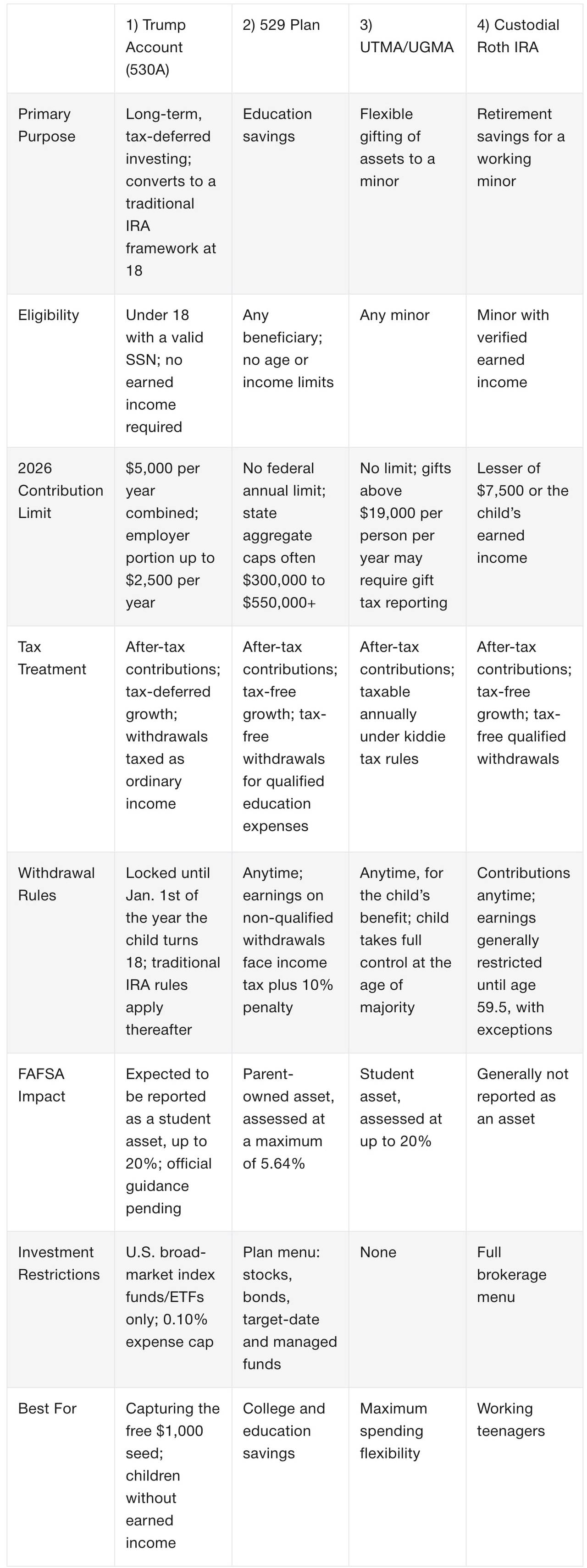
Trump Account vs. 529 Plan: The Most Common Comparison
What Is a 529 Plan?
A 529 plan is a state-sponsored education savings account. If you’re new to the concept, start with our overview of how 529 college savings plans are structured. The essentials:
- Tax-free growth and tax-free withdrawals for qualified education expenses—including tuition, room and board, K-12 tuition, vocational training, and student loan repayment.
- There’s no federal annual contribution limit; state aggregate caps apply, often between $300,000 and $550,000.
- Up to $35,000 (lifetime) of leftover 529 funds can be rolled into a Roth IRA for the beneficiary, subject to holding-period and other rules.
- For common questions, see how 529 plans work and whether one is right for your child.
Key Differences: Tax Treatment
529 Plan: Tax-free growth plus tax-free qualified withdrawals: the strongest tax efficiency available for education spending.
Trump Account (530A): Tax-deferred growth plus ordinary income tax on withdrawals: less tax-efficient, but not tied to education spending.
Key Differences: FAFSA and Financial Aid Impact
- 529 plans are reported as a parent-owned asset on the FAFSA. The federal Student Aid Index (SAI, which replaced the Expected Family Contribution) counts at most 5.64% of parent-owned assets, so the impact on need-based aid is modest.
- Trump Accounts are widely expected by financial aid experts to be reported as a student-owned asset, assessed at up to 20% of the account balance, which would reduce aid eligibility far more sharply. Note that the Department of Education has not yet issued official guidance; some analysts believe the account’s IRA structure could eventually qualify it for the retirement-account exclusion. Until guidance arrives, families with children close to college age should plan around the less favorable treatment.
- For the mechanics, see how education savings accounts affect your child’s FAFSA eligibility and SavingForCollege.com’s Trump Account vs. 529 analysis.
Key Differences: Investment Options
- 529 plans offer broad menus: stock funds, bond funds, target-date portfolios, and actively managed options.
- Trump Accounts are restricted to broad-market U.S. stock index funds and ETFs with expense ratios of 0.10% or less; no bonds and no actively managed funds.
What If Your Child Doesn’t Go to College?
A child not going to college is a common concern with 529 plans, and it’s more manageable than many parents assume. Unused 529 funds can be transferred to a sibling’s 529, applied to vocational training, or rolled into a Roth IRA for the beneficiary (up to the $35,000 lifetime limit). A Trump Account, by contrast, simply continues under traditional IRA rules at 18 regardless of whether the child attends college, which gives it more built-in flexibility on this specific point.
Can Your Child Have Both?
Many financial advisors recommend having both tax-advantaged savings vehicles. A family can claim the $1,000 government seed in a Trump Account and simultaneously fund a 529 plan for education. These two tax-advantaged savings vehicles serve different purposes and are not mutually exclusive. J.P. Morgan’s analysis of 529 plans vs. Trump Accounts reaches the same conclusion: For newborns, the answer is often both.
Trump Account vs. UTMA/UGMA Custodial Accounts
What Is a UTMA or UGMA Account?
- Custodial investment accounts that are governed by the Uniform Transfers to Minors Act (UTMA) or Uniform Gifts to Minors Act (UGMA).
- Has no contribution limits, though gifts above $19,000 per person in 2026 may require gift tax reporting.
- Offers maximum flexibility: Funds can be used for any purpose that benefits the child—whether college, a car, travel, or a business startup.
- Earnings are taxed annually under the kiddie tax: In 2026, the first $1,350 of unearned income is tax-free, the next $1,350 is taxed at the child’s rate, and amounts above $2,700 are taxed at the parents’ marginal rate.
- At the state-defined age of majority, typically 18 to 25, the child gains full, unrestricted control of the assets.
Key Differences from a Trump Account
- A UTMA has no investment restrictions, versus the Trump Account’s U.S. index-fund-only rule.
- A UTMA has no contribution limit, versus the Trump Account’s $5,000 annual cap.
- A UTMA is counted as a student asset on the FAFSA, so on financial aid, the two accounts are expected to land in a similar place.
- UTMA funds can be accessed at any time for the child’s benefit, subject to annual tax consequences, versus the Trump Account’s hard lock until age 18.
Gift Tax Considerations for UTMA Contributions
Because UTMAs have no contribution ceiling, they are a common landing spot for larger gifts from grandparents and other relatives. Anyone planning a substantial transfer should understand that using the annual gift tax exclusion to fund accounts for your child: Staying at or below $19,000 per giver, per child, per year, keeps the gift below the federal reporting threshold.
A Note on Children with Special Needs
UTMA and UGMA accounts are generally not appropriate for children who receive, or may later receive, means-tested government benefits, because assets held in the child’s name can jeopardize eligibility. Specialized tools such as ABLE accounts and special needs trusts exist for this purpose.
Trump Account vs. Custodial Roth IRA
What Is a Custodial Roth IRA?
- A Roth IRA that’s opened by a parent or guardian on behalf of a minor child.
- The child must have verified earned income, such as W-2 wages or self-employment income, which is the most important restriction.
- The 2026 contribution limit is the lesser of $7,500 or the child’s total earned income.
- Offers tax-free growth plus tax-free qualified withdrawals in retirement.
- Roth IRAs are generally not counted as assets on the FAFSA, the most favorable financial aid treatment among the four account types.
- Contributions (not earnings) can be withdrawn at any time without penalty, and earnings may qualify for penalty-free early withdrawal for a first-time home purchase or qualified education expenses.
Trump Account vs. Custodial Roth IRA: The Key Trade-Off
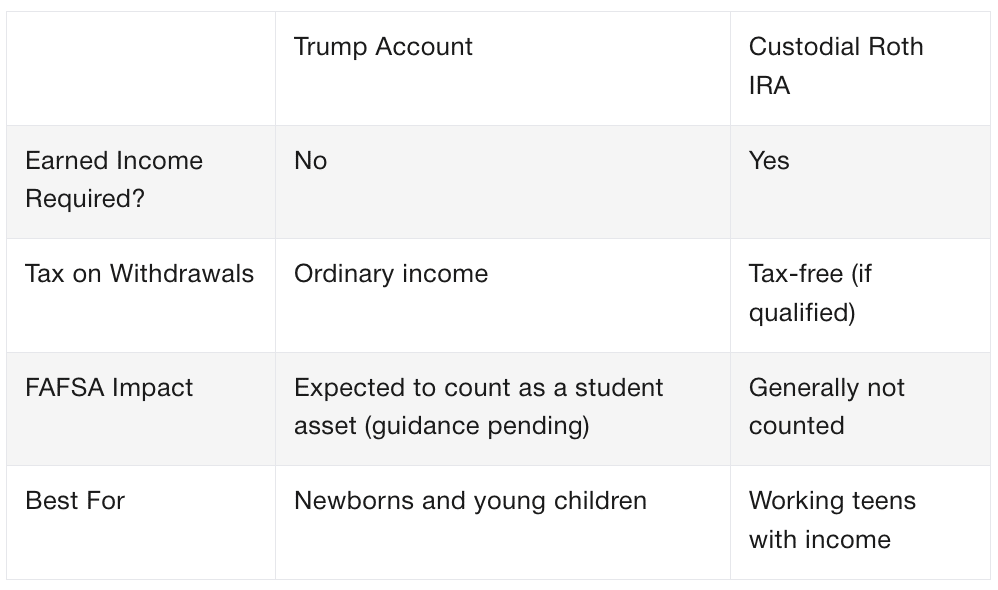
Is a Trump Account Better Than a Roth IRA?
For working teenagers, a custodial Roth IRA is generally the stronger tax-advantaged savings vehicle: decades of tax-free compounding, qualified tax-free withdrawals, and better financial aid treatment. For young children with no earned income, a Trump Account is the only IRA-style option available, so the question is less either/or than when each becomes available to your family. Advisors quoted by CNBC make the same point: Trump Accounts are not the only option when it comes to child investments.
Which Tax-Advantaged Savings Vehicle Account Is Right for Your Child? A Decision Framework
Best for College Savings: 529 Plan
529 plans offer superior tax efficiency for education (tax-free growth and withdrawals). They’re the best FAFSA treatment of any account on this list except the Roth IRA, and have wide investment options. If paying for college is your primary goal, a 529 should anchor your strategy.
Best for Working Teenagers: Custodial Roth IRA
If your child has earned income from a part-time job or self-employment, a custodial Roth IRA can deliver the greatest long-term tax benefit: decades of tax-free compounding with flexible withdrawal options for education or a first home.
Best for Maximum Spending Flexibility: UTMA/UGMA
If you want to give your child funds usable for any purpose at the age of majority—whether college, a car, a business, or travel—a UTMA offers the fewest restrictions and no contribution ceiling.
Best for Capturing the Government Seed: Trump Account (530A)
If your child is under 18, and especially if you have a newborn born between 2025 and 2028, opening a Trump Account to claim the $1,000 government deposit costs you nothing and gives your child a tax-deferred investment head start that does not require earned income.
Best Strategy for Many Families: Use Them Together
For many families, the most effective approach is layered: open a Trump Account to capture the government seed, fund a 529 for education, and open a Roth IRA when your child begins working. These tax-advantaged savings vehicles are complementary, not competing. It’s one piece of the broader work of preparing your children for long-term financial independence.
Talk to an Advisor Before You Decide
Choosing among these four tax-advantaged savings vehicles involves long-term tax implications, financial aid consequences, and estate planning dimensions that are easy to miss on your own, and the right answer often changes as your child grows. A fiduciary advisor can help you weigh tax-efficient investment strategies for families and build a plan around your children’s long-term financial independence, rather than around any singular tax-advantaged savings vehicle.
This story was produced by Wealth Enhancement and reviewed and distributed by Stacker.


