
Renting a car on your next trip? Here's what your auto insurance covers on a rental car

Renting a car on your next trip? Here's what your auto insurance covers on a rental car
For freedom and flexibility on vacation, travelers often opt for a rental car. Having your own set of wheels means you can go where you want and when you want.
Your personal car insurance covers a rental car on a U.S. vacation with the same liability, collision and comprehensive coverage you already carry on your own vehicle. That is one reason just 10% of renters buy insurance at the rental counter, according to a July 2024 Consumer Reports survey of more than 6,000 members.
That protection carries the same deductible you pay at home, and it follows you into Canada. But if you carry a liability-only policy, you have no comprehensive or collision coverage to extend, so nothing on your own insurance pays to fix or replace a rental car that gets wrecked or stolen.
Your credit card can cover the rental car itself, but it pays nothing toward the injuries or property damage you cause someone else. That comes from your own auto policy, which extends to a rental driven for personal use and pays first. Rental agreements usually include liability at the state minimum, which is what covers a renter with no policy of their own, though not every agreement does. The minimum is low either way, so confirm what the contract includes and buy supplemental liability at the counter to raise the limit.
Below, Insure.com explains what you need to know about insurance coverage for your rental car.
What insurance do you need to rent a car for vacation?
Personal car insurance covers a rental car driven for personal travel in the U.S. and Canada, applying the same coverage types, limits and deductibles that appear on your own policy. Whatever coverages you carry at home are what you carry on the rental, too.
If you carry a $1,000 collision deductible, you pay the first $1,000 of the rental's repair bill. If you carry your state's minimum liability limits, those same limits are all that protect you after a crash.
The Insurance Information Institute recommends calling your insurer and your card issuer before you rent, because the counter is where travelers pay for coverage they already have.
What rental car coverage your auto policy includes
Full coverage on your personal vehicle extends three protections to a rental car, and each one works exactly as it does on your car. Your deductible comes with them; that’s the amount you pay out of pocket before your insurer contributes. A $600 bumper repair on a rental car can cost you the full $600 if that is your deductible, because the carrier pays nothing until the deductible is met.
Rental companies bill loss-of-use fees for the money they lose while a damaged car sits in the shop, plus an administrative fee for handling the claim. Personal auto policies differ on whether they pay either one. Ask your insurer about an add-on that covers those fees, which costs less than buying the same protection by the day at the counter.
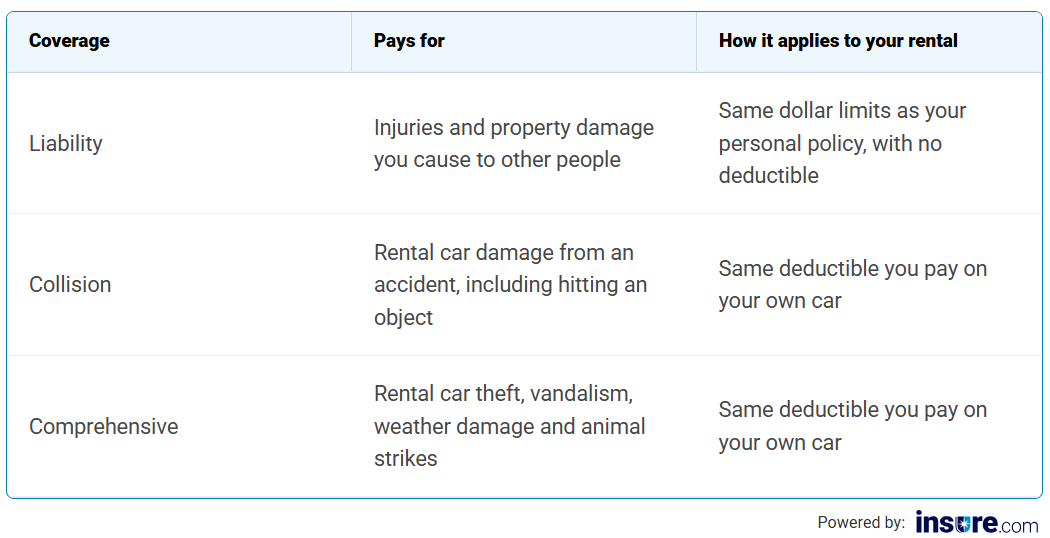
Remember, if you only have liability insurance on your personal vehicle, you won’t have comprehensive or collision coverage on a rental car.
When your personal policy won't cover a rental
Your personal policy doesn’t cover a rental car when you carry liability-only insurance, drive outside the U.S. and Canada, rent for business use, or keep the car longer than your policy allows.
- A liability-only policy leaves the rental car unprotected. Liability pays only for damage you cause to other people. Damage to the rental itself, theft of the rental or a tree branch falling on the rental are all yours to pay.
- Travel outside the U.S. and Canada is not covered by the policy. Standard U.S. auto policies are written for U.S. and Canadian roads, so Mexico, Europe, the Caribbean and everywhere else require separate coverage.
- Business use voids personal coverage. A rental picked up for a client visit, a delivery route or rideshare driving is a commercial use, and personal policies exclude it.
- Long-term rentals stop being covered. Rentals that stretch into weeks or months, and any lease, generally need to be added to a policy in writing before coverage applies.
Insurers commonly exclude exotic cars, high-value vehicles, cargo vans, RVs and moving trucks from rental coverage, so call your agent before you book a wedding-weekend convertible or a 26-foot moving truck.
How can you use a credit card to cover rental car insurance?
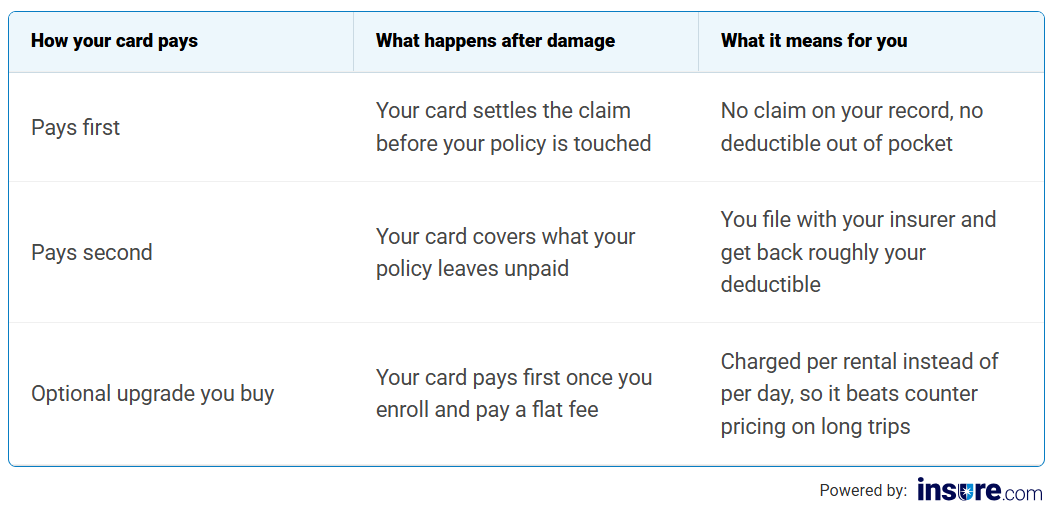
Credit card coverage pays for damage to or theft of the rental car and nothing else, so it never pays for the injuries or property damage you cause. Credit card coverage replaces the damage waiver sold at the counter, not your liability insurance.
What changes from card to card is who pays first, the dollar limit and the day cap. Cards also exclude exotic and high-value cars, trucks, motorcycles, car-sharing rentals booked through platforms like Turo, and countries including Ireland, Israel and Jamaica. Your card's benefit guide is the only place those details appear, so read it before you book.
How do you activate credit card rental car coverage?
Credit card coverage activates only if you pay for the rental with that card, decline the rental company's damage waiver, and appear on the rental agreement as the renter. To activate credit card rental car coverage:
- Pay the full rental cost with that card. Splitting the charge or switching cards at the counter can void the coverage.
- Decline the damage waiver. Accepting it hands over responsibility to the rental company and switches off your card.
- Get your name on the agreement. The cardholder must be the renter, and every additional driver must be listed.
Even if you follow all these steps, credit card rental car coverage might not apply in some situations.
Rental car insurance options at the counter
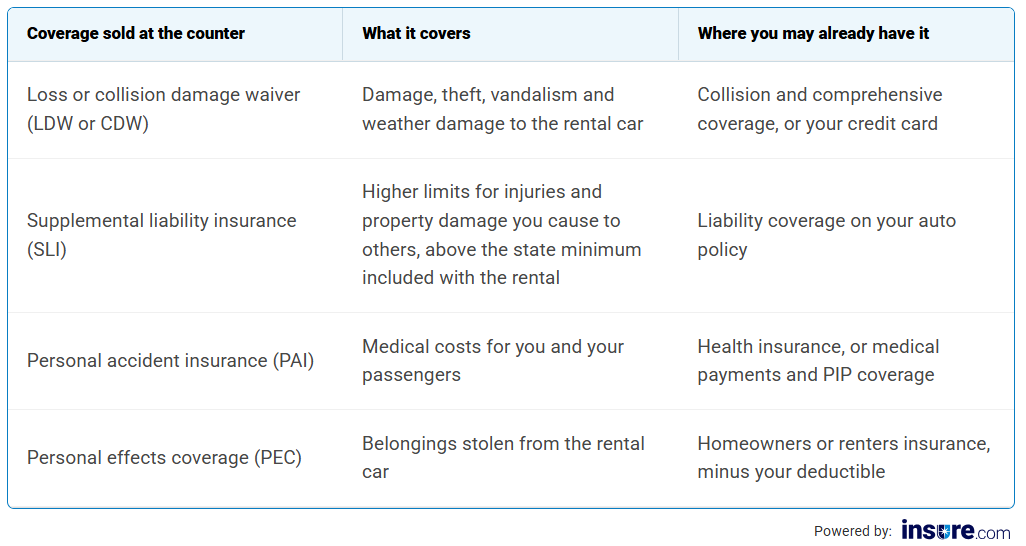
Rental companies sell a damage waiver, supplemental liability, personal accident coverage and personal effects coverage, and each one overlaps something you may already have. The damage waiver is not insurance. It is a rental company agreement not to bill you for damage to its car, and it can be canceled if you do anything the contract forbids, like driving on unpaved roads.
Everything at the counter is priced per day, so the cost increases with each day of your trip.
Do I need rental car insurance for my vacation?
Skip the counter coverage if you carry full coverage on your own car and are paying with a card that covers rental damage. Buy at the counter when your trip has a gap your own coverage does not reach, such as:
- You have no auto policy, or liability only, and no card coverage. Nothing is protecting the rental car itself.
- You carry state-minimum liability limits. Supplemental liability raises them for the trip without affecting your premium.
- You are traveling outside the U.S. and Canada. Your policy stops at the border, and most cards exclude some countries.
- You are renting an RV, a moving truck, a high-value car or a work vehicle. These are the most common exclusions on both policies and cards.
- Your rental runs longer than 15 to 42 days. That range is where card coverage cuts off.
- You want to keep a claim off your record. A waiver costs a set amount up front, while a claim can raise your premium at every renewal that follows.
Does rental car insurance cover driving in Mexico or Canada?
Your personal car insurance covers a rental in Canada but not in Mexico, where liability coverage must be provided by a Mexican-licensed insurer. The U.S. State Department's Mexico country information page notes that Mexican car insurance is required for every vehicle and that uninsured drivers in an accident may be arrested.
Buy a Mexican liability policy before you cross, through the rental company, your own insurer, or a specialist seller. Tell the rental company where you are going, because many U.S. rental agreements ban crossing into Mexico, and doing it anyway voids everything you paid for.
Renting a car when you don't own one
Without your own car insurance, the rental company and your credit card are the only sources of coverage. That coverage has to pay for repairs if you damage the rental car, and for the other driver's medical bills and car repairs if you cause a crash.
Here’s how to make sure you’re covered:
- The rental company sells coverage for its own car, sometimes called a damage waiver. It pays to fix or replace the car if you crash it or someone steals it, and you're charged for every day of the rental.
- Your credit card may cover the same thing for free. Call the number on the back and ask, because if it does, you can pay for the rental with that card and turn down the coverage at the counter.
- With neither one, you pay for the damage yourself. That means the full repair bill, or the value of the car if it's stolen or totaled.
- The rental comes with liability coverage, but only your state's minimum. That pays the other driver's bills when you cause a crash, and one serious injury can cost more than the minimum coverage, so make sure to buy supplemental coverage at the counter to raise the amount.
- Breaking the rental agreement cancels the coverage. Driving on unpaved roads or letting someone who isn't on the contract take the wheel leaves you on the hook.
Rental car tips for your next trip
Book early for the best rate and selection, then use the week before pickup to settle your coverage and paperwork.
- Confirm your coverage in writing. Ask your insurer to email confirmation, and download your card's benefit guide to your phone.
- List every driver on the rental agreement. An unlisted driver who crashes can void the contract and the coverage that comes with it.
- Photograph the car from all angles at pickup and return. Time-stamped photos defeat a damage claim for a scratch that was already there.
- Check the fuel policy before you leave the lot. Prepaid fuel charges for a full tank, whether you use it or not.
- Set up the car before you shift out of park. Adjust the mirrors, find the wipers and connect your phone.
Adjust the seat and mirrors, locate the wiper and turn signal controls, and connect your phone for GPS if needed. Then hit the road and make some memories.
Rental car insurance FAQ
Does my insurance deductible apply to a rental car?
Yes, the same deductible you have for your personal vehicle carries over to a rental car.
Am I covered driving a rental in Canada or Mexico?
Your personal car insurance policy will provide coverage in Canada but not Mexico. Let the car rental company know your plans to travel to Mexico so they can review your insurance options.
Does rental coverage extend to additional drivers?
Your rental coverage will extend to all drivers listed on the rental agreement. If someone is not listed on the agreement and is involved in an accident while driving, the claim might not be covered.
Will a rental car claim raise my premium?
It can if you file a claim with your personal auto insurance carrier. For this reason, some people look for credit cards that offer primary rental car insurance coverage, since it can eliminate the need to file a claim with their insurer.
This story was produced by Insure.com and reviewed and distributed by Stacker.


