
HOLY COW! HISTORY: The Jewish man who created a Christmas classic
You know Dasher and Dancer and Prancer and Vixen. And yes, you still recall the most famous reindeer of all.
But how did that red-nosed misfit become a key character in Yuletide celebrations? He …
This item is available in full to subscribers.
Subscribe to continue reading. Already a subscriber? Sign in
Local news from Lexington's only local news source. Subscribe today.
Please log in to continue |
HOLY COW! HISTORY: The Jewish man who created a Christmas classic


You know Dasher and Dancer and Prancer and Vixen. And yes, you still recall the most famous reindeer of all.
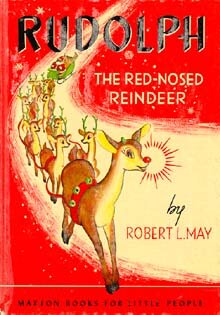
But how did that red-nosed misfit become a key character in Yuletide celebrations? He wasn’t one of the original eight tiny reindeer, after all. Just who gave him to us?
Would you believe it was a Jewish man with a dying wife who had a little daughter and worked for a big company?
This was how those circumstances combined to create a Christmas classic.
Robert May (Bob to family and friends) grew up in a prosperous Jewish family outside New York City. When the Great Depression hit, his family was financially ruined.
Bob and wife Evelyn moved to Chicago, where he worked at Montgomery Ward as a copywriter for their famous catalogs. The hours were long, and the pay was low. But in those days, just having a job—any job—was a blessing. Daughter Barbara was soon born.
The Mays’ happiness didn’t last long.
Evelyn developed cancer in 1937, a diagnosis that was often a death sentence back then. Bob spent every penny he had (and then some) getting the best medical treatment possible as he watched Evelyn slowly waste away.
As he struggled with a sick wife and deepening debt, Bob’s boss tasked him with a special assignment in January 1939. Montgomery Ward gave customers a free holiday children’s book every Christmas. Oh, and make it an animal story, he added.
How could an animal relate to Christmas? Bit by bit, the answer slowly came to him.
He remembered when they visited Chicago’s Lincoln Park Zoo, the now four-year-old Barbara was crazy about deer. Maybe that should be the featured animal. Santa’s sleigh was pulled by reindeer, after all.
As Evelyn grew sicker, Bob spent hours at her bedside each night. She told him how she had been painfully shy as a child, and how other kids cruelly made fun of her and excluded her from their games because of it. Evelyn still felt the pain of being ostracized.
That got Bob thinking. He remembered later, “Suppose he (the story’s hero) was an underdog, a loser, yet triumphant in the end. But what kind of loser? Certainly, a reindeer’s dream would be to pull Santa’s sleigh.”
Pondering that while staring out his office window one day, nature came to the rescue. Thick fog from Lake Michigan blocked the view. “Suddenly, I had it! A nose! A bright red nose that would shine through fog like a spotlight.”
Bob toyed with different names. Reginald … Rollo … then Rudolph. That was it: Rudolph the Red-Nosed Reindeer.
Bob excitedly took the story to his boss.
And the boss hated it. He really, really hated it, saying, “For gosh sakes, Bob, can’t you do better than that?”
But Bob refused to give up on Rudolph. He asked a friend in the company’s art department, “Could you draw a deer with a big red nose and still make him look appealing?”
So, the next Saturday morning, Bob, little Barbara and the artist visited the zoo’s deer pen. On Monday morning, the men took their design back to the boss. “Bob,” he said softly after seeing it, “forget what I said before and put that story into finished form.”
Bob began turning the story into a poem. While he was writing it, Evelyn died in July.
Bob was devastated. His boss suggested taking time off work and handing over the project to someone else. Bob shook his head. “I needed Rudolph now more than ever. Gratefully, I buried myself in the work. Finally, in late August, it was done.”
Bob called Barbara and Evelyn’s parents into their living room and read them the finished poem. “In their eyes, I could see that the story accomplished what I had hoped,” he recalled.
When the little book was given to customers that Christmas, it was a huge hit. The company distributed 2.5 million copies. By 1946, it had grown to 6 million.
That same year, a record company wanted to produce a spoken word version of the poem. But there was a problem: Montgomery Ward owned the rights to Rudolph’s story and image.
Some brave soul took the matter directly to Ward’s big boss, the notoriously crusty, tough-as-nails Sewell Avery.
Yet something touched Avery’s heart. Maybe it was sympathy for Bob having lost his wife; maybe it was appreciation for all the favorable publicity Bob’s creation had generated for Wards. Whatever the reason, to the company’s utter astonishment, Avery handed over the rights to Rudolph to Bob.
A few years later, Bob’s brother-in-law Johnny Marks wrote the famous “Rudolph the Red-Nosed Reindeer.” But Marks had as tough a time bringing it to life as Bob had experienced producing his book. Bing Crosby, Dinah Shore and other popular entertainers passed on it. Cowboy singer Gene Autry finally put it on vinyl just to make his wife stop pestering him about it. And it was on the “B Side” at that.
But Autry changed his tune when “Rudolph” became the Number 1 song in America for Christmas week 1949. The record was a runaway success, selling 2.5 million copies that year alone, eventually becoming the second best-selling holiday record of all time, behind Bing Crosby’s “White Christmas."
Rudolph assumed a life of his own. For example, a 1964 TV special about him was one of the very first annual Christmas programs for children. Countless books, videos and cartoons have told the story. And in perhaps the greatest acknowledgment of its success, the U. S. Postal Service honored Rudolph with his own postage stamp in 2014.
As for Bob, he went on to marry a colleague and have five more children. Rudolph provided him with a comfortable income but didn’t make him rich. He passed away in 1976.
So, what was his payoff? As Bob May said, “Today, children all over the world hear of the little deer who started out in life as a loser, just as I did. But … when he gave himself over to others, his handicap became the very means through which he achieved happiness. My reward is knowing that every year, when Christmas rolls around, Rudolph still brings that message to millions, both young and old.”
And just as the other reindeer promised, Rudolph the Red-Nosed Reindeer did indeed go down in history.
Have comments, questions or suggestions you’d like to share with Mark? Message him at jmp.press@gmail.com.


Comments
No comments on this item Please log in to comment by clicking here